
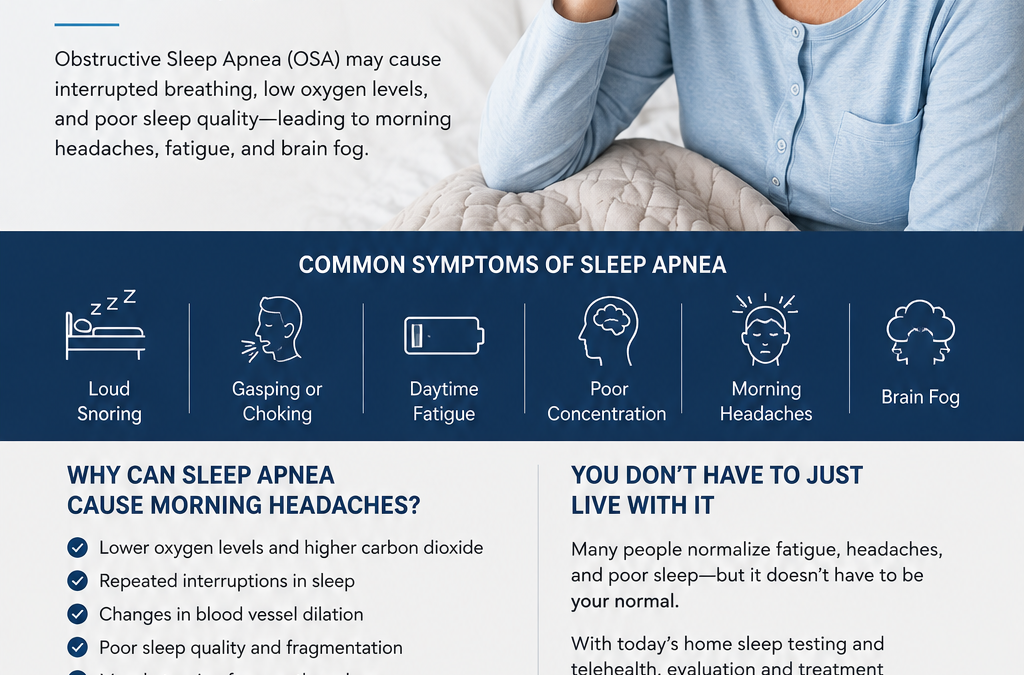
Can Sleep Apnea Cause Morning Headaches?
Many people wake up with headaches and assume the cause is stress, dehydration, neck tension, or poor sleep posture. However, in some patients, recurring morning headaches may actually be related to Obstructive Sleep Apnea (OSA).
Because sleep apnea often goes undiagnosed for years, patients may not realize that interrupted breathing during sleep can affect oxygen levels, sleep quality, and overall brain function.
At DPC Medical, we provide confidential telehealth evaluations for Minnesota patients concerned about sleep apnea symptoms, fatigue, poor sleep, and related health issues.
What Is Obstructive Sleep Apnea?
Obstructive Sleep Apnea is a condition in which the airway repeatedly narrows or collapses during sleep.
These breathing interruptions may occur dozens — or even hundreds — of times per night.
Common symptoms may include:
Loud snoring
Gasping or choking during sleep
Daytime fatigue
Poor concentration
Dry mouth upon waking
Restless sleep
Morning headaches
Brain fog
Mood changes or irritability
Untreated OSA has also been associated with cardiovascular disease, high blood pressure, diabetes, and cognitive impairment.
Why Can Sleep Apnea Cause Morning Headaches?
During episodes of sleep apnea, oxygen levels may temporarily decrease while carbon dioxide levels rise.
At the same time, the brain experiences repeated micro-awakenings throughout the night in order to restart breathing.
These repeated interruptions may contribute to:
Poor sleep quality
Sleep fragmentation
Changes in blood vessel dilation
Reduced oxygen delivery
Muscle tension from restless sleep
The result for some patients is waking up feeling:
Groggy
Mentally foggy
Exhausted
Headachy
Unrefreshed despite “sleeping all night”
Many patients describe the headache as a dull pressure or tightness that improves later in the morning.
Many Patients Normalize the Symptoms
One major challenge with sleep apnea is that patients often adapt to feeling poorly over time.
Fatigue, headaches, poor concentration, and low energy are frequently blamed on:
Aging
Stress
Anxiety
Busy schedules
Poor sleep habits
However, sleep experts increasingly emphasize that symptom minimization delays diagnosis and treatment.
Sleep Apnea Does Not Always Look the Same
While loud snoring is common, not every patient presents with classic symptoms.
Research and awareness campaigns now recognize that women and some older adults may present differently, sometimes with:
Insomnia
Morning headaches
Fatigue
Mood changes
Brain fog
Poor sleep quality without dramatic snoring
This is one reason why many patients remain undiagnosed.
How Is Sleep Apnea Diagnosed?
Many patients today qualify for home sleep testing rather than requiring an overnight sleep lab.
Advances in home sleep testing and telehealth have made diagnosis more accessible and convenient for many adults.
Depending on the patient, treatment options may include:
CPAP therapy
Weight management
Positional therapy
Oral appliance therapy
Sleep habit optimization
Minnesota Telehealth Sleep Apnea Evaluations
At DPC Medical, we offer confidential telehealth evaluations for Minnesota patients concerned about:
Sleep apnea
Snoring
Fatigue
Brain fog
Poor sleep
Morning headaches
CPAP treatment questions
📞 Call 763-588-7099 to schedule an evaluation.
Looking for an alternative to CPAP? Request a consultation here: