
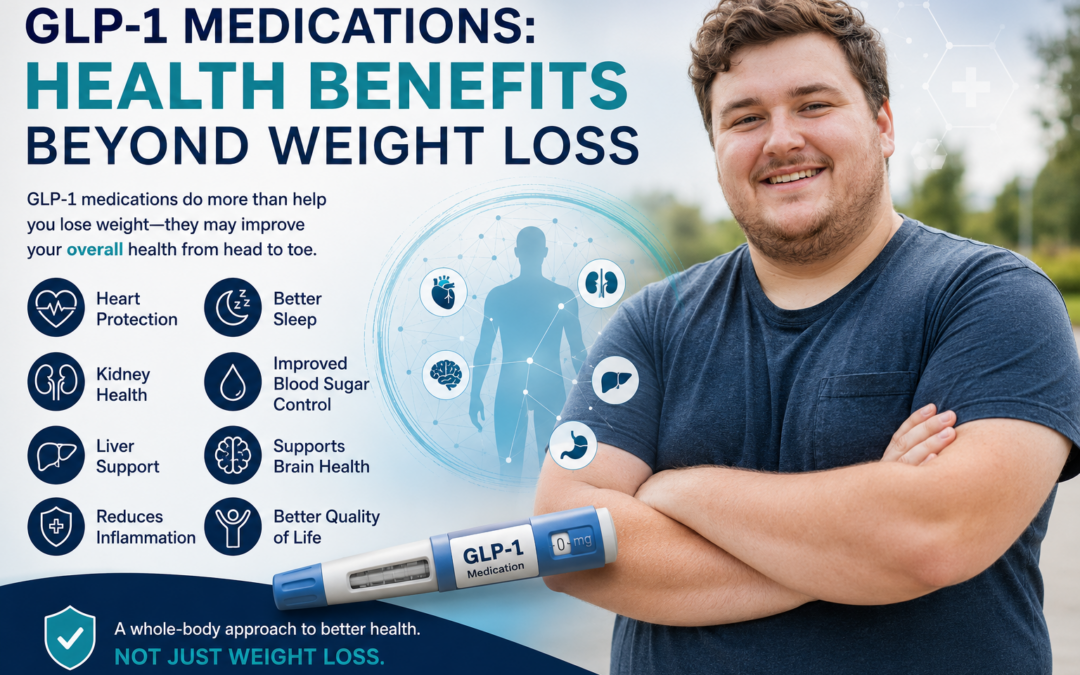
For many people, GLP-1 medications are known simply as “weight-loss injections.” While weight reduction is certainly an important benefit, research over the last several years has revealed something much more remarkable.
Scientists now recognize that GLP-1 receptor agonists may improve health throughout the entire body—including the heart, kidneys, liver, brain, sleep, and metabolic system. These medications are rapidly changing the way physicians think about chronic disease prevention and treatment.
If you’re considering GLP-1 therapy, it’s important to understand that the number on the scale is only one measure of success.
What Are GLP-1 Medications?
GLP-1 (Glucagon-Like Peptide-1) receptor agonists mimic a naturally occurring hormone produced in the intestine after eating. These medications help regulate:
- Blood sugar
- Appetite
- Insulin secretion
- Glucagon release
- Stomach emptying
- Brain satiety signals
Common GLP-1 medications include:
- Semaglutide (Ozempic®, Wegovy®)
- Tirzepatide (Mounjaro®, Zepbound®)
- Liraglutide (Victoza®, Saxenda®)
- Dulaglutide (Trulicity®)
Originally developed to treat Type 2 diabetes, these medications have become some of the most extensively studied drugs in modern medicine.
1. Heart Protection
One of the biggest discoveries has been cardiovascular protection.
Large clinical trials have demonstrated that GLP-1 medications can reduce the risk of:
- Heart attack
- Stroke
- Cardiovascular death
- Major adverse cardiac events (MACE)
Researchers believe these benefits occur through multiple mechanisms, including:
- Reduced inflammation
- Improved blood vessel function
- Lower blood pressure
- Better cholesterol metabolism
- Improved endothelial function
Importantly, many of these cardiovascular benefits appear to extend beyond weight loss alone.
2. Kidney Protection
Kidney disease affects millions of Americans.
Recent research has shown GLP-1 medications may:
- Slow kidney disease progression
- Reduce protein leakage into the urine
- Lower the risk of kidney failure
- Reduce cardiovascular complications associated with chronic kidney disease
In 2025, the FDA expanded Ozempic’s labeling to include reduction of kidney disease progression in certain patients with Type 2 diabetes and chronic kidney disease.
3. Liver Health
Fatty liver disease (MASLD/MASH) has become one of America’s fastest-growing chronic diseases.
Studies have shown GLP-1 medications may:
- Reduce liver fat
- Improve liver inflammation
- Improve insulin resistance
- Slow progression toward liver fibrosis
Researchers continue to study whether these medications may eventually become standard treatment for metabolic liver disease.
4. Reduced Inflammation
Chronic inflammation contributes to many diseases, including:
- Heart disease
- Arthritis
- Kidney disease
- Diabetes
- Obesity
Emerging evidence suggests GLP-1 medications have anti-inflammatory effects independent of weight loss.
Scientists believe lowering inflammation may explain many of the broad health improvements seen in clinical trials.
5. Better Sleep
Weight loss alone can improve sleep, but GLP-1 medications may provide additional benefits.
Clinical studies have demonstrated improvements in:
- Obstructive Sleep Apnea
- Sleep quality
- Daytime fatigue
- Oxygen levels during sleep
This is especially important because untreated sleep apnea increases the risk of heart disease and stroke.
6. Improved Blood Sugar Control
Even individuals without diabetes may benefit from improved metabolic regulation.
GLP-1 medications help:
- Improve insulin sensitivity
- Reduce insulin resistance
- Lower glucose spikes after meals
- Reduce pancreatic stress
These improvements may delay or prevent progression from prediabetes to Type 2 diabetes in appropriate patients.
7. Brain Health
Researchers are investigating whether GLP-1 medications may help protect the brain.
Early studies suggest possible benefits in:
- Cognitive function
- Dementia risk
- Parkinson’s disease
- Alzheimer’s disease
Although these findings are promising, additional randomized clinical trials are still needed before these medications can be recommended specifically for neurological diseases.
8. Improved Quality of Life
Many patients report improvements in everyday life, including:
- Increased energy
- Less joint pain
- Easier mobility
- Improved confidence
- Better exercise tolerance
- Reduced food cravings
- Improved relationship with food
While individual experiences vary, these improvements often make healthy lifestyle changes easier to maintain.
9. A New Era in Preventive Medicine
Medical experts increasingly view GLP-1 therapy as part of comprehensive cardiometabolic care rather than simply a weight-loss treatment.
Ongoing research continues to evaluate benefits for:
- Osteoarthritis
- Substance use disorders
- Chronic inflammation
- Certain cancers
- Fertility
- Healthy aging
Some of these areas remain investigational, but the pace of new discoveries has been remarkable.
Are GLP-1 Medications Right for Everyone?
No.
These medications should always be prescribed after a comprehensive medical evaluation.
Some patients should not take GLP-1 medications, and others require close monitoring for possible side effects such as:
- Nausea
- Vomiting
- Constipation
- Gallbladder disease
- Pancreatitis (rare)
- Gastrointestinal intolerance
A qualified healthcare provider can determine whether GLP-1 therapy is appropriate based on your medical history and treatment goals.
The Bottom Line
GLP-1 medications represent one of the most significant advances in metabolic medicine in decades.
While many people first hear about these medications because of weight loss, growing evidence shows they may also improve heart health, kidney function, liver disease, sleep apnea, inflammation, metabolic health, and overall quality of life.
As research continues, GLP-1 therapy is becoming less about losing pounds—and more about improving long-term health.
If you’re interested in learning whether GLP-1 therapy may be appropriate for you, speak with a healthcare provider experienced in obesity medicine and metabolic health.
Suggested Internal Links
Use these as hyperlinks within your website:
- Learn more about our GLP-1 Medical Weight Management Program
- Find out if you qualify for treatment
- Meet our medical providers
- Schedule your consultation today
- Read our previous blog: Understanding GLP-1 Medications
- Frequently Asked Questions about GLP-1 Therapy
Recommended External Links
For readers who want authoritative information, consider linking to:
- American Diabetes Association Standards of Care
- American Heart Association
- National Institute of Diabetes and Digestive and Kidney Diseases (NIDDK)
- National Institutes of Health (PubMed)
- FDA Drug Safety Information
References
- Gupta N, et al. Beyond Blood Sugar: A Scoping Review of GLP-1 Receptor Agonists. 2025.
- Yang HM, et al. GLP-1 Agonists in Cardiovascular Diseases. 2025.
- Gonzalez-Rellan MJ, et al. The Expanding Benefits of GLP-1 Medicines. 2025.
- Wong CK, et al. Anti-inflammatory Actions of GLP-1–Based Medicines. 2025.
- Chen TH, et al. GLP-1 Receptor Agonists and Cardiovascular and Kidney Outcomes. 2025.
- U.S. FDA approval of semaglutide (Ozempic) for chronic kidney disease risk reduction in eligible patients with type 2 diabetes.