
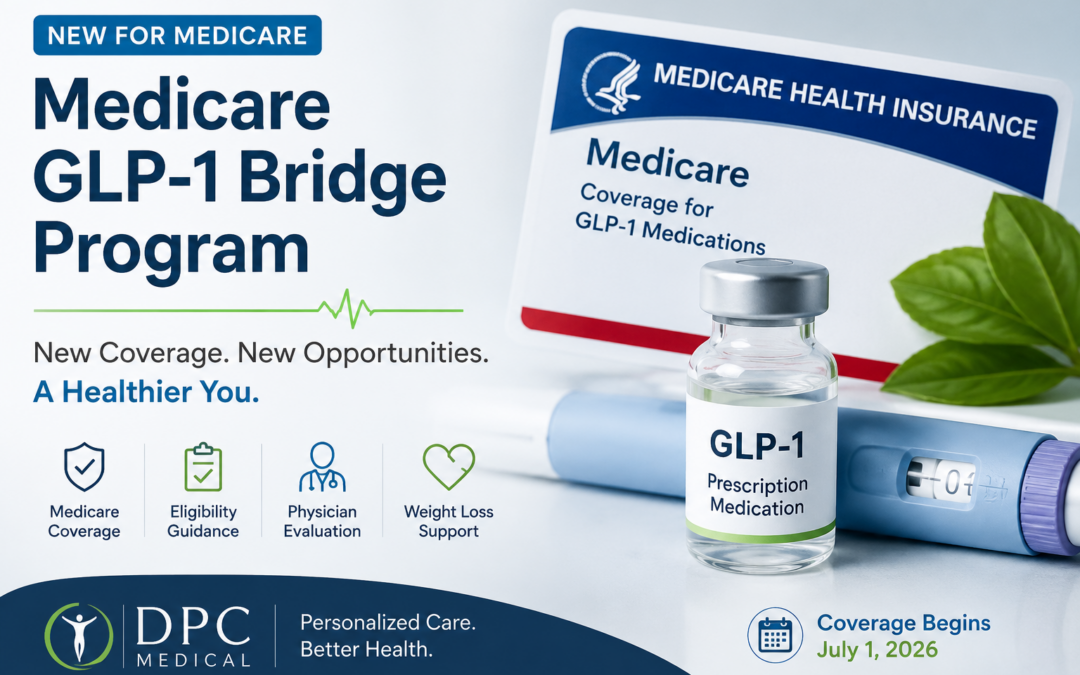
A Review of the Science Behind Medicare’s New Approach to Obesity Treatment and Cardiovascular Disease Prevention
Beginning in July 2026, the Centers for Medicare & Medicaid Services (CMS) launched the Medicare GLP-1 Bridge Program, a temporary demonstration initiative designed to provide eligible Medicare Part D beneficiaries with affordable access to GLP-1 and GLP-1/GIP medications for obesity treatment. For many seniors, this represents the first meaningful opportunity to receive modern obesity medications for a predictable monthly copayment.
But an important question remains:
Why would Medicare invest billions of dollars in covering weight-loss medications?
The answer lies in an increasingly impressive body of scientific evidence demonstrating that obesity treatment with GLP-1 medications is about much more than losing weight. Modern research suggests these medications can reduce the risk of heart attack, stroke, cardiovascular death, progression to diabetes, kidney disease, and other obesity-related complications.
New to the Medicare GLP-1 Bridge Program? Read our complete guide explaining how the program works, who qualifies, and what benefits are available. Read our companion article, Medicare’s New GLP-1 Bridge Program: Everything You Need to Know Beginning July 1, 2026.
Why the Bridge Program Was Created
For decades, Medicare generally excluded medications prescribed solely for weight loss, even though obesity is now recognized as a chronic disease associated with serious medical complications.
The Medicare GLP-1 Bridge Program was created to temporarily close this gap while CMS gathers real-world data on patient outcomes, medication utilization, and overall costs before deciding on broader long-term Medicare coverage. The program operates outside the traditional Medicare Part D payment system and provides eligible beneficiaries access to qualifying medications for a fixed $50 monthly copayment.
The Evidence Begins with Cardiovascular Disease
Cardiovascular disease remains the leading cause of death among older adults.
Historically, weight-loss medications primarily focused on reducing body weight. Today’s GLP-1 medications have changed that conversation by demonstrating measurable reductions in major cardiovascular events.
The Landmark SELECT Trial
Perhaps the most influential study supporting Medicare’s decision was the SELECT Trial, published in The New England Journal of Medicine in 2023.
Researchers studied 17,604 adults who:
- Had obesity or were overweight
- Had established cardiovascular disease
- Did not have diabetes
Patients receiving weekly semaglutide (2.4 mg) experienced:
- 20% reduction in cardiovascular death, heart attack, or stroke
- Nearly 10% average body weight loss
- Lower blood pressure
- Reduced systemic inflammation
- Benefits that appeared early and continued throughout treatment
This was the first large randomized clinical trial to demonstrate that treating obesity itself could significantly reduce major cardiovascular events, even in people without diabetes.
Wondering whether you may qualify for Medicare’s GLP-1 Bridge Program? Our team can help determine your eligibility, review your medical history, and discuss whether GLP-1 therapy may be appropriate for your individual health goals. Call DPC Medical-Dodson Pain Consultants, PA at 763-588-7099.
Multiple Studies Confirm the Findings
One clinical trial is encouraging.
Several studies pointing in the same direction are much stronger evidence.
Researchers have now analyzed tens of thousands of patients across numerous randomized controlled trials.
Among the findings:
- A meta-analysis of 29 randomized controlled trials involving more than 37,000 patients found significant reductions in major adverse cardiovascular events, heart attacks, and all-cause mortality among patients receiving GLP-1 receptor agonists.
- Another systematic review involving nearly 100,000 patients demonstrated reductions in cardiovascular mortality, overall mortality, and major adverse cardiovascular events across numerous patient populations, including individuals without diabetes.
When independent studies repeatedly reach similar conclusions, physicians become increasingly confident that the benefits are real rather than occurring by chance.
Benefits Extend Beyond Weight Loss
Although weight reduction receives the most public attention, GLP-1 medications appear to improve several important markers of overall health.
Studies have demonstrated improvements in:
- Blood pressure
- Cholesterol profiles
- Systemic inflammation
- Insulin resistance
- Risk of developing Type 2 diabetes
- Kidney protection
- Heart failure symptoms in selected patients
These improvements likely work together to reduce long-term cardiovascular risk.
For many patients, the medication is helping treat an entire metabolic disease process—not simply reducing body weight.
Why Prevention Matters
One of the most compelling reasons behind the Medicare Bridge Program is prevention.
Obesity increases the likelihood of developing:
- Type 2 diabetes
- Heart attack
- Stroke
- Heart failure
- Chronic kidney disease
- Obstructive sleep apnea
- Reduced mobility and disability
Preventing these complications could improve quality of life while potentially reducing future healthcare costs.
Although long-term cost-effectiveness continues to be studied, preventing even a portion of these expensive chronic illnesses could offset some of the cost of expanding medication coverage.
Challenges Remain
The evidence supporting GLP-1 therapy is impressive, but these medications are not without limitations.
Researchers continue to study several important questions:
- Long-term cost-effectiveness
- Medication adherence outside clinical trials
- Weight regain after stopping therapy
- Drug pricing
- Appropriate patient selection
Real-world studies suggest many patients discontinue treatment within one to two years, often because of medication cost or insurance barriers. The Medicare Bridge Program attempts to address one of the largest barriers—affordability—while also encouraging lifestyle modification alongside medication therapy.
Our Perspective
The Medicare GLP-1 Bridge Program was not created simply because these medications help people lose weight.
Rather, it reflects growing scientific evidence that treating obesity may help prevent serious medical conditions before they occur.
The strongest evidence currently demonstrates reductions in heart attack, stroke, and cardiovascular death among appropriately selected patients. Additional research continues to explore benefits involving kidney disease, heart failure, diabetes prevention, and other obesity-related illnesses.
As always, GLP-1 medications are not appropriate for every patient. Treatment decisions should be individualized after discussing medical history, risks, benefits, and alternative options with a qualified healthcare provider.
Frequently Asked Questions
Is the Medicare GLP-1 Bridge Program designed only for weight loss?
No. While weight loss is an important goal, the scientific evidence supporting the program extends beyond weight reduction. Clinical trials have shown that GLP-1 medications may reduce the risk of heart attack, stroke, cardiovascular death, and progression to Type 2 diabetes in appropriately selected patients.
Why did Medicare create the GLP-1 Bridge Program?
The program was developed to improve access to FDA-approved GLP-1 medications for eligible beneficiaries while CMS evaluates the long-term health benefits, patient outcomes, and economic impact of expanded obesity treatment.
What scientific study provided the strongest evidence for the program?
One of the landmark studies was the SELECT Trial, published in The New England Journal of Medicine in 2023. The trial found that semaglutide reduced the combined risk of cardiovascular death, heart attack, and stroke by approximately 20% in adults with overweight or obesity and established cardiovascular disease who did not have diabetes.
Does everyone with obesity qualify for the Medicare GLP-1 Bridge Program?
No. Eligibility is determined by CMS program requirements and includes specific clinical criteria. Patients should speak with their healthcare provider to determine whether they qualify.
Are GLP-1 medications a substitute for healthy eating and exercise?
No. The Medicare Bridge Program emphasizes that medication should be combined with lifestyle changes, including healthy nutrition, regular physical activity, and ongoing medical follow-up to achieve the greatest benefit.
Will taking a GLP-1 medication prevent heart disease?
No medication can guarantee prevention. However, multiple large clinical studies have shown that GLP-1 receptor agonists can significantly reduce the risk of major cardiovascular events in appropriately selected patients.
Are there risks or side effects?
Yes. Like all prescription medications, GLP-1 therapies may cause side effects, including nausea, vomiting, diarrhea, constipation, and, in rare cases, more serious complications. Patients should discuss the risks and benefits with their healthcare provider before starting treatment.
Is the Medicare GLP-1 Bridge Program permanent?
At this time, the BALANCE Model is a CMS demonstration program. CMS will evaluate patient outcomes, healthcare utilization, costs, and overall effectiveness before determining whether broader Medicare coverage should be adopted.
Can GLP-1 medications help prevent diabetes?
For many patients with obesity or prediabetes, studies suggest GLP-1 medications may reduce the risk of progressing to Type 2 diabetes by promoting substantial weight loss and improving insulin sensitivity. While results vary by individual, this potential for disease prevention is one reason these medications have generated significant interest among healthcare professionals.
If you would like to learn whether you may qualify for the Medicare GLP-1 Bridge Program or have questions about GLP-1 medications and medical weight management, the healthcare team at DPC Medical–Dodson Pain Consultants is here to help. Please complete our secure Inquiry Form to contact our office. A member of our team will review your request, answer your questions, and contact you to discuss your treatment options and determine whether you may be a candidate for therapy.
References
- Lincoff AM, Brown-Frandsen K, Colhoun HM, et al. Semaglutide and Cardiovascular Outcomes in Obesity without Diabetes. New England Journal of Medicine. 2023.
- Galli M, Benenati S, Laudani C, et al. Cardiovascular Effects and Tolerability of GLP-1 Receptor Agonists: A Systematic Review and Meta-analysis of 99,599 Patients. Journal of the American College of Cardiology. 2025.
- Leite AR, Angélico-Gonçalves A, Vasques-Nóvoa F, et al. Effect of Glucagon-like Peptide-1 Receptor Agonists on Cardiovascular Events in Overweight or Obese Adults Without Diabetes. Diabetes, Obesity & Metabolism. 2022.
- Ansari HUH, Qazi SU, Sajid F, et al. Efficacy and Safety of GLP-1 Receptor Agonists on Body Weight and Cardiometabolic Parameters in Individuals With Obesity and Without Diabetes. Endocrine Practice. 2024.
- Gilbert O, Gulati M, Gluckman TJ, et al. 2025 ACC Expert Consensus Statement on Medical Weight Management for Optimization of Cardiovascular Health. Journal of the American College of Cardiology. 2025.
- Gasoyan H, Rothberg MB. CMS BALANCE Model for Obesity—Implications for Patients and Clinicians. JAMA. 2026.
- Hwang JH, Laiteerapong N, Huang ES, et al. Fiscal Impact of Expanded Medicare Coverage for GLP-1 Receptor Agonists to Treat Obesity. JAMA Health Forum. 2025.