
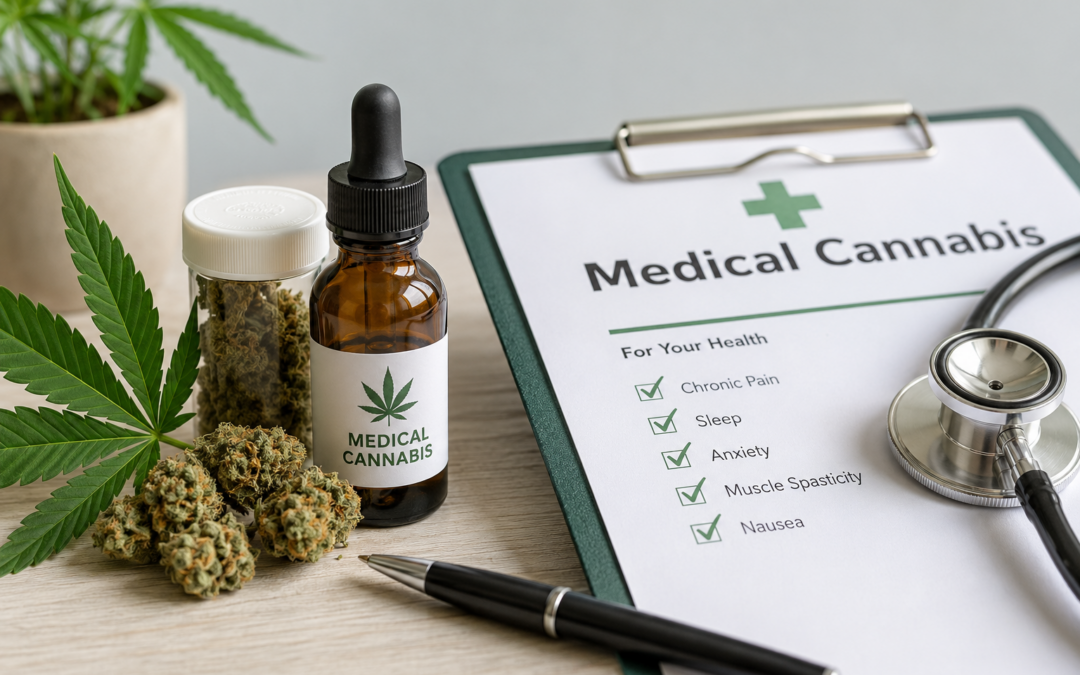
Medical cannabis has moved from the margins of medicine into a serious conversation between patients and healthcare providers.
People living with chronic pain, muscle spasms, cancer-related symptoms, post-traumatic stress disorder (PTSD), and other persistent medical conditions may wonder whether cannabis could be another option when conventional treatments have not provided enough relief.
But an important question remains:
What does the medical evidence actually say about cannabis?
The answer is more nuanced than either “cannabis works” or “cannabis doesn’t work.” Research suggests that cannabinoids may provide meaningful symptom relief for some patients and conditions, but the benefits, risks, appropriate products, and individual response can vary considerably.
What Is Medical Cannabis?
Cannabis contains numerous naturally occurring compounds known as cannabinoids. The two most familiar are:
THC (tetrahydrocannabinol) — the cannabinoid primarily responsible for the intoxicating effects associated with cannabis. THC may also influence pain perception, nausea, appetite, sleep, and muscle spasticity.
CBD (cannabidiol) — a cannabinoid that does not produce the same intoxicating effect as THC. CBD has been studied for several potential therapeutic applications, although evidence varies considerably depending on the medical condition and product being studied.
Cannabinoids interact with the body’s endocannabinoid system, a signaling system involved in functions including pain processing, mood, appetite, sleep, memory, and immune activity.
That is one reason researchers continue to investigate cannabinoids across a wide range of medical conditions.
Can Medical Cannabis Help Chronic Pain?
Chronic pain is one of the most common reasons patients consider medical cannabis.
Research suggests that cannabis-based medicines can produce small improvements in pain for some patients, although they should not be viewed as a guaranteed treatment or cure.
A clinical practice guideline published in The BMJ evaluated evidence from randomized clinical trials involving people with chronic cancer and non-cancer pain. The expert panel issued a weak recommendation for a trial of non-inhaled medical cannabis or cannabinoids when standard care has not been sufficient.
The recommendation was considered weak rather than strong because the expected improvements in pain, physical functioning, and sleep tend to be small, while adverse effects also need to be considered.
In practical terms, this means medical cannabis may be reasonable for selected patients, particularly when symptoms remain troublesome despite other treatment approaches.
What About Sleep?
Pain and sleep frequently affect one another.
A person experiencing persistent pain may have difficulty falling asleep, wake repeatedly during the night, or struggle to find a comfortable sleeping position. Poor sleep can then make coping with pain even more difficult the following day.
Research reviewed in the chronic-pain literature suggests cannabinoids may produce small improvements in sleep quality for some patients with chronic pain.
That doesn’t mean cannabis should automatically be considered a treatment for insomnia. Instead, improvement in sleep may sometimes occur as part of the overall symptom response in appropriately selected patients.
Medical Cannabis and Muscle Spasms
Cannabinoids have also been investigated for muscle spasticity, particularly in neurological conditions.
Minnesota’s Medical Cannabis Program specifically recognizes severe and persistent muscle spasms, including those associated with multiple sclerosis, among its qualifying medical conditions.
For patients experiencing significant spasticity, cannabis may therefore be one treatment option worth discussing with a qualified healthcare practitioner.
What Other Conditions May Qualify in Minnesota?
Minnesota’s medical cannabis program currently identifies numerous qualifying conditions.
Examples include:
- Chronic pain
- Intractable pain
- Cancer under specified circumstances
- Post-traumatic stress disorder (PTSD)
- Seizures, including those associated with epilepsy
- Severe and persistent muscle spasms
- Inflammatory bowel disease, including Crohn’s disease
- Irritable bowel syndrome
- Obstructive sleep apnea
- Sickle cell disease
- Tourette syndrome
- HIV/AIDS
- ALS
- Terminal illness under specified circumstances
Minnesota law also now defines a qualifying medical condition to include a medical condition for which an individual’s healthcare practitioner has recommended, approved, or authorized cannabis to treat the condition.
Eligibility does not automatically mean cannabis is the right treatment for every individual. A patient’s medical history, medications, symptoms, treatment goals, and potential risks should all be considered.
Why Medical Cannabis Is Not the Same as Recreational Cannabis
The distinction is important.
The purpose of medical cannabis treatment is not simply intoxication. The goal is to identify whether cannabinoid therapy may provide a clinically useful improvement in a particular patient’s symptoms while minimizing unwanted effects.
A medical evaluation may consider questions such as:
What symptom are we trying to improve?
What treatments have already been attempted?
Could cannabis interact with the patient’s medications?
Does the patient have conditions that increase the risks associated with THC?
Would a THC-dominant, CBD-dominant, or balanced approach be more appropriate?
How will we determine whether treatment is actually helping?
This individualized approach is one of the major differences between medical decision-making and recreational cannabis use.
What Are the Potential Side Effects?
Cannabis is not risk-free.
Depending on the cannabinoid, dose, formulation, route of administration, and individual patient, adverse effects can include:
- Dizziness
- Drowsiness or fatigue
- Impaired attention or coordination
- Dry mouth
- Nausea
- Changes in mood or perception
- Cognitive effects
- Increased heart rate
- Intoxication, particularly with THC-containing products
Cannabis can also interact with medications and may be inappropriate for certain patients.
Patients should be especially cautious about driving or operating machinery while impaired.
The possibility of side effects is another reason medical cannabis should be approached as a medical decision rather than simply a consumer product.
Is Medical Cannabis an Alternative to Opioids?
This question deserves careful wording.
Medical cannabis should not be described as a universal replacement for opioid medication, and patients should never abruptly discontinue prescribed opioids or other medications simply because they begin using cannabis.
However, for some patients with chronic symptoms, cannabinoid therapy may be considered as one component of a broader treatment strategy.
The objective is not necessarily to replace one drug with another. The objective is to find the safest combination of treatments that improves function, comfort, sleep, and quality of life while minimizing harm.
Medical Cannabis in Minnesota
Minnesota residents who are considering the state’s Medical Cannabis Program should begin with a qualified healthcare practitioner.
Minnesota requires practitioners to have an appropriate medical relationship with the patient and assess the patient’s medical history and current condition before certification.
For an initial certification, the state advises practitioners to conduct a thorough examination, review relevant medical records and diagnostic information, and develop an ongoing treatment plan.
Patients must also meet the state’s program requirements.
What About Iowa?
Iowa maintains a separate Medical Cannabis Program administered by the Iowa Department of Health and Human Services.
Iowa residents may qualify when an authorized healthcare practitioner certifies that the patient has a qualifying debilitating medical condition.
Because Minnesota and Iowa operate separate programs with different laws and requirements, patients should follow the rules applicable to the state in which they are seeking certification.
Who Should Consider Talking With a Healthcare Provider?
A medical cannabis evaluation may be worth discussing if you:
- Have a persistent medical condition affecting your quality of life
- Continue to experience symptoms despite conventional treatment
- Are interested in whether cannabis might complement your existing treatment plan
- Want to understand the potential benefits and risks before trying cannabis
- Need help understanding Minnesota or Iowa medical cannabis eligibility
Certification does not mean cannabis will work for every patient.
Instead, the evaluation provides an opportunity to discuss your medical condition, previous treatments, medications, potential risks, and treatment goals with a healthcare professional.
The Bottom Line
Medical cannabis is neither a miracle cure nor something that should automatically be dismissed.
The evidence suggests that cannabinoids can provide modest symptom improvement for some appropriately selected patients, particularly in areas such as chronic pain, while benefits must be weighed against possible adverse effects.
The most useful question may therefore not be:
“Does medical cannabis work?”
A better question is:
“For my particular medical condition, symptoms, medications, and treatment goals, is medical cannabis a reasonable option to consider?”
That is a conversation worth having with a qualified healthcare provider.
For further information please contact us.
References
- Busse JW, Vankrunkelsven P, Zeng L, et al. Medical cannabis or cannabinoids for chronic pain: a clinical practice guideline. BMJ. 2021;374. doi:10.1136/bmj.n2040.
- Minnesota Office of Cannabis Management, Division of Medical Cannabis. Qualifying Medical Conditions. State of Minnesota. Accessed August 2026.
- Minnesota Office of Cannabis Management, Division of Medical Cannabis. How to Participate as a Health Care Practitioner. State of Minnesota. Accessed August 2026.
- Minnesota Statutes §342.01. Definitions — Qualifying Medical Condition. Minnesota Legislature.
- Minnesota Rules §9810.4003. Medical Cannabis Patient Registry; Health Care Practitioner Qualifications and Duties.
- Iowa Department of Health and Human Services. Medical Cannabis Program. Bureau of Cannabis Regulation. Accessed August 2026.
- Iowa Department of Health and Human Services. Medical Cannabis for Patients & Caregivers. Accessed August 2026.