
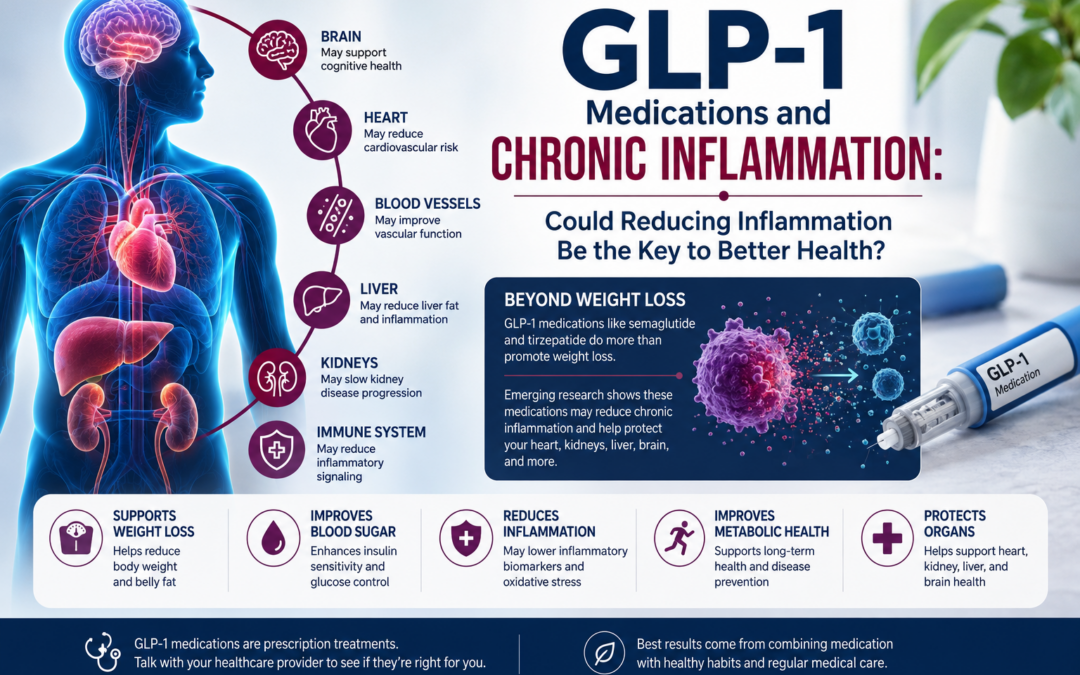
Why Are GLP-1 Medications Helping So Many Different Medical Conditions?
For years, GLP-1 medications such as semaglutide (Wegovy®, Ozempic®) and tirzepatide (Zepbound®, Mounjaro®) were viewed primarily as weight-loss or diabetes medications.
Today, researchers are discovering something much more exciting.
Many experts now believe that reducing chronic inflammation may be one of the major reasons these medications improve health throughout the body.
Instead of affecting only body weight, GLP-1 medications appear to influence the heart, kidneys, liver, blood vessels, immune system, brain, joints, and even sleep quality.
The result is that many physicians are beginning to think of GLP-1 medications as whole-body metabolic health medications rather than simply weight-loss drugs. Emerging evidence suggests that some benefits may occur partly independent of weight loss itself.
What Is Chronic Inflammation?
Inflammation is the body’s natural defense system.
When you cut your finger, inflammation helps it heal.
But chronic low-grade inflammation is different.
Instead of helping, it quietly damages tissues over many years.
Researchers now associate chronic inflammation with:
- Heart disease
- Stroke
- Obesity
- Type 2 diabetes
- Fatty liver disease
- Chronic kidney disease
- Arthritis
- Sleep apnea
- Cognitive decline
Because inflammation affects nearly every organ system, reducing it may improve overall health—not just body weight.
How Do GLP-1 Medications Reduce Inflammation?
Scientists are still learning exactly how these medications work.
Current research suggests several mechanisms:
Better Blood Sugar Control
High blood sugar damages blood vessels and increases inflammation.
GLP-1 medications improve glucose regulation, reducing this inflammatory burden.
Less Visceral (Belly) Fat
Visceral fat is metabolically active and releases inflammatory chemicals called cytokines.
As visceral fat decreases, inflammatory signaling often decreases as well.
Healthier Blood Vessels
GLP-1 medications appear to improve endothelial function—the health of the lining inside blood vessels.
Healthier arteries mean:
- Better circulation
- Lower blood pressure
- Reduced cardiovascular stress
Immune System Effects
Researchers have identified direct effects of GLP-1 receptors on immune cells.
These effects may reduce production of inflammatory molecules throughout the body.
Health Conditions That May Benefit
❤️ Heart Disease
One of the strongest areas of evidence involves cardiovascular disease.
Large clinical trials have shown reductions in:
- Heart attack
- Stroke
- Cardiovascular death
- Heart failure symptoms in selected patients
These benefits extend beyond blood sugar control and have influenced modern cardiology guidelines.
Kidney Disease
The kidneys contain millions of tiny blood vessels that are especially vulnerable to chronic inflammation.
Recent studies show GLP-1 medications may help:
- Slow kidney disease progression
- Reduce protein leakage
- Lower risk of kidney failure
- Reduce cardiovascular complications in kidney disease
Fatty Liver Disease (MASLD/MASH)
Fat accumulation in the liver often leads to inflammation and scarring.
GLP-1 medications have shown promising results by:
- Reducing liver fat
- Improving liver inflammation
- Helping some patients reverse early liver injury
This remains one of the fastest-growing areas of research.
Sleep Apnea
Weight loss clearly improves obstructive sleep apnea.
However, researchers also suspect improvements in inflammation and metabolic function may contribute to better sleep quality.
Some GLP-1 therapies are now FDA-approved for certain patients with obesity and obstructive sleep apnea.
Arthritis and Joint Pain
Less body weight means less stress on joints.
Reduced inflammation may provide an additional benefit by improving mobility and decreasing pain in some individuals.
Research continues in this area.
Are GLP-1 Medications Anti-Aging?
This question appears frequently online.
The honest answer is:
We don’t know yet.
Researchers are studying whether reducing chronic inflammation could slow certain age-related diseases.
Some early findings suggest possible benefits for healthy aging, but more long-term studies are needed before making anti-aging claims.
Are These Medications Right for Everyone?
No.
GLP-1 medications are prescription medications that should be used under medical supervision.
Your healthcare provider will evaluate:
- Medical history
- Current medications
- Insurance coverage
- Potential side effects
- Individual treatment goals
These medications work best when combined with healthy nutrition, regular physical activity, adequate sleep, and long-term lifestyle changes.
The Bottom Line
GLP-1 medications have become one of the most important advances in metabolic medicine in decades.
While weight loss remains a major benefit, growing evidence suggests these medications may also improve health by reducing chronic inflammation throughout the body.
Researchers continue to discover new ways GLP-1 therapies may help protect the heart, kidneys, liver, blood vessels, and other organs.
As science evolves, GLP-1 medications are increasingly viewed not simply as weight-loss drugs, but as tools for improving overall metabolic health.
Frequently Asked Questions
Do GLP-1 medications reduce inflammation?
Current research suggests they can reduce several markers of chronic inflammation through multiple metabolic and immune-related pathways.
Are inflammation benefits independent of weight loss?
Some studies indicate that certain cardiovascular, kidney, and anti-inflammatory benefits may occur partly independent of weight loss, although weight reduction remains an important contributor.
Can GLP-1 medications help prevent heart disease?
Several large clinical trials have shown reductions in cardiovascular events among appropriate high-risk patients. Your healthcare provider can determine whether you are a candidate.
Will GLP-1 medications cure obesity?
No. Obesity is considered a chronic disease. These medications work best as part of a long-term treatment plan that includes healthy lifestyle habits.
Have Questions: See below
- “Read our guide: Everything you need to know beginning July 1, 2026 → Our previous health blog on Medicare’s New GLP-1 Bridge Program.
- “Find out whether you may qualify for GLP-1 therapy” → Fill out our inquiry form and we can contact you. You under no obligation to schedule. Call us for more information.
- “Contact our clinic to schedule a consultation” → Contact page:
References (2025–2026)
- Quintana L, Tabaza N, Kurt B, Kahles F. Anti-inflammatory effects of GLP1-RA drugs. The Journal of Clinical Endocrinology & Metabolism. 2026. doi:10.1210/clinem/dgag218.
- Wong CK, Drucker DJ. Antiinflammatory Actions of Glucagon-Like Peptide-1-Based Therapies Beyond Metabolic Benefits. The Journal of Clinical Investigation. 2025;135(21). doi:10.1172/JCI194751.
- Ros-Madrid I, Cano-Mármol RP, Ferrer-Gómez M, Ramos-Molina B. Anti-Inflammatory Properties of GLP-1 Receptor Agonists and Other Ancillary Benefits From a Pharmacological Perspective. Canadian Journal of Physiology and Pharmacology. 2025;103(12):369–377. doi:10.1139/cjpp-2025-0148.
- Nauck MA, Tuttle KR, Tschöp MH, Blüher M. Glucagon-Like Peptide-1 Receptor Agonists and Next-Generation Incretin-Based Medications: Metabolic, Cardiovascular, and Renal Benefits. The Lancet. 2026;407:892–908.
- Wong CK, McLean BA, Baggio LL, et al. Central Glucagon-Like Peptide 1 Receptor Activation Inhibits Toll-Like Receptor Agonist-Induced Inflammation. Cell Metabolism. 2024;36(1):130–143.e5. doi:10.1016/j.cmet.2023.11.009.
- Kassab MB, Khraishah H, Thrapp A, et al. Glucagon-Like Peptide-1 Receptor Agonists Reduce Experimental Atherosclerosis Progression, Inflammatory Biomarkers and Cardiovascular Events, Irrespective of Hyperglycaemia and Obesity. European Heart Journal. 2026. doi:10.1093/eurheartj/ehag060.