
If you have been diagnosed with obstructive sleep apnea (OSA), chances are you have heard that Continuous Positive Airway Pressure (CPAP) therapy is considered the gold standard treatment. While CPAP is highly effective, many patients struggle to tolerate wearing a mask every night.
The good news is that CPAP is not the only treatment option. Oral Appliance Therapy (OAT) has become an evidence-based alternative for many patients with obstructive sleep apnea, particularly those who cannot tolerate CPAP.
What Is Oral Appliance Therapy?
An oral appliance is a custom-made device worn during sleep that gently repositions the lower jaw forward. This helps keep the airway open and reduces airway collapse that can occur during sleep.
Unlike CPAP, which uses air pressure delivered through a mask, oral appliance therapy is compact, portable, and does not require electricity.
Does It Really Work?
Yes.
The American Academy of Sleep Medicine (AASM) recommends custom, titratable oral appliances as an effective treatment option for patients with obstructive sleep apnea who are unable to tolerate CPAP or prefer an alternative treatment.
Studies consistently show that oral appliances significantly reduce:
Apnea-Hypopnea Index (AHI)
Oxygen desaturation events
Sleep disruptions
Snoring
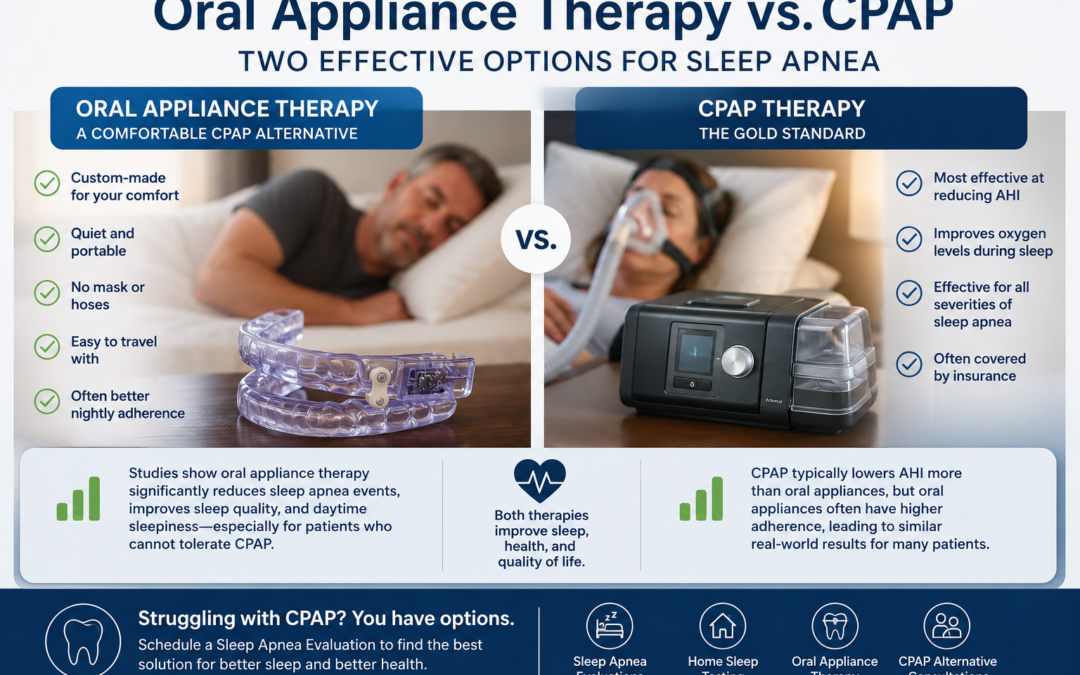
While CPAP generally produces greater reductions in AHI, oral appliances still provide meaningful improvements for many patients.
CPAP vs Oral Appliance Therapy
CPAP Advantages
CPAP remains the most effective treatment for reducing sleep apnea events.
Benefits include:
Greater reduction in AHI
Improved oxygen levels during sleep
Effective treatment across all severity levels of sleep apnea
For patients who can comfortably use CPAP every night, it remains an excellent treatment option.
Oral Appliance Advantages
However, effectiveness is not only about how well a treatment works in a laboratory—it is also about whether patients actually use it.
Research has shown that patients often wear oral appliances longer each night than they use CPAP. Higher adherence can help narrow the real-world difference between the two treatments.
Patients frequently prefer oral appliances because they are:
Smaller and more comfortable
Easy to travel with
Quiet
Mask-free
Easier to tolerate long term
What About Daytime Sleepiness and Quality of Life?
Interestingly, studies have found that improvements in:
Daytime sleepiness
Daily functioning
Quality of life
are often similar between CPAP and oral appliance therapy.
In other words, even though CPAP may reduce more breathing events, many patients experience similar improvements in how they feel during the day when using a properly fitted oral appliance.
Can Oral Appliances Help Heart Health?
Untreated sleep apnea has been associated with:
High blood pressure
Heart disease
Stroke
Irregular heart rhythms
Diabetes
Research suggests that oral appliance therapy can lower blood pressure and may provide cardiovascular benefits comparable to CPAP in many patients.
Because sleep apnea affects the entire body, successful treatment is important regardless of which evidence-based therapy is used.
Who Is a Good Candidate for Oral Appliance Therapy?
You may be a good candidate if you:
Cannot tolerate CPAP
Remove your CPAP mask during sleep
Travel frequently
Have mild or moderate obstructive sleep apnea
Have severe sleep apnea but are unable to use CPAP consistently
Want to explore alternatives before considering surgery
A complete evaluation is necessary to determine whether oral appliance therapy is appropriate for your individual situation.
Why Follow-Up Testing Matters
Not every patient responds to treatment in the same way.
After an oral appliance has been fitted and adjusted, a follow-up sleep study is often recommended to confirm that the treatment is effectively controlling sleep apnea.
This helps ensure that the therapy is providing meaningful improvement in breathing, oxygen levels, and sleep quality.
The Bottom Line
CPAP remains the most effective treatment for reducing sleep apnea events. However, oral appliance therapy is a proven, evidence-based alternative that can provide substantial benefits for many patients.
For patients who struggle with CPAP, oral appliance therapy may offer a comfortable and effective path toward better sleep, improved daytime energy, and long-term health benefits.
Schedule a Sleep Apnea Evaluation
If you snore, feel tired during the day, have been diagnosed with sleep apnea, or struggle with CPAP therapy, we can help.
DPC Medical and DPC Dental provide:
Sleep Apnea Evaluations
Home Sleep Testing
Oral Appliance Therapy Consultations
CPAP Alternative Evaluations
Interested in learning whether a CPAP alternative may be right for you? Schedule a CPAP Alternative Consultation or contact us at 763-588-7099
Contact our office to learn whether oral appliance therapy may be right for you.
Medical Disclaimer: This article is for educational purposes only and should not replace individualized medical or dental advice. Treatment recommendations should be based on a comprehensive evaluation by a qualified healthcare professional. Not every patient is a candidate for oral appliance therapy. Treatment recommendations depend on the severity of sleep apnea, medical history, and individual circumstances. A comprehensive evaluation can help determine the most appropriate option.
References
Ramar K, Dort LC, Katz SG, et al. Clinical Practice Guideline for the Treatment of Obstructive Sleep Apnea and Snoring with Oral Appliance Therapy: An Update for 2015. Journal of Clinical Sleep Medicine. 2015;11(7):773-827.
Bratton DJ, Gaisl T, Wons AM, Kohler M. CPAP vs Mandibular Advancement Devices and Blood Pressure in Patients With Obstructive Sleep Apnea: A Systematic Review and Meta-analysis. JAMA. 2015;314(21):2280-2293.
Phillips CL, Grunstein RR, Darendeliler MA, et al. Health Outcomes of Continuous Positive Airway Pressure Versus Oral Appliance Treatment for Obstructive Sleep Apnea: A Randomized Controlled Trial. American Journal of Respiratory and Critical Care Medicine. 2013;187(8):879-887.
Doff MHJ, Hoekema A, Wijkstra PJ, et al. Oral Appliance Versus Continuous Positive Airway Pressure in Obstructive Sleep Apnea Syndrome: A 2-Year Follow-up. Sleep. 2013;36(9):1289-1296.